






I love how confidently people explain history online. Give them a photograph, some dramatic music and the words “What schools never taught you,” and suddenly we are all being educated by someone who hasn’t checked it either. The claim that Hollywood actress Hedy Lamarr invented Wi-Fi is a perfect example. It sounds brilliant, it celebrates an extraordinary woman, and it gives everyone something impressive to share. There is just one small inconvenience: that isn’t what she invented.
Before anyone thinks I am here to dismiss her, Lamarr was a genuine inventor. During World War II, she worked with composer George Antheil on a system intended to stop enemies interfering with radio-controlled torpedoes. Their idea was to make the transmitter and receiver switch radio frequencies together, making the signal harder to jam. Think of two people changing channels in sync while the person trying to interrupt them keeps losing the conversation.
That is clever and commendable. A Hollywood actress working on military communications alongside a composer is already a story worth telling. Apparently, though, it needed a router before social media could appreciate it.
They filed their “Secret Communication System” patent on 10 June 1941 and received US Patent 2,292,387 on 11 August 1942. It names both Hedy Kiesler Markey, the name Lamarr used then, and George Antheil. Yes, George was involved too. If we are correcting history to give people their missing credit, perhaps we could avoid removing someone else in the process.
So why does her name keep appearing beside Wi-Fi? There is a connection, but it needs explaining. Their work belongs to the history of frequency-hopping communication, and the original 1997 IEEE 802.11 wireless networking standard included a frequency-hopping option. That does not mean their torpedo-control invention was Wi-Fi, or that today’s router is simply their device with a password underneath.
Calling Lamarr the “mother of Wi-Fi” is a popular tribute. BUT, Treating that nickname as proof that she invented Wi-Fi is misleading. Somewhere between the actual achievement and the caption, several decades of engineering have quietly disappeared.
Now, if you are expecting me to reveal the one man who really invented Wi-Fi, we have another problem. There wasn’t one person responsible for the whole thing. I know, very inconsiderate of history to make this difficult for everyone preparing a men-versus-women argument.
Wi-Fi grew through contributions from researchers, companies and the IEEE standards group. Vic Hayes chaired that group from 1990 to 2000, helping develop the shared rules that allowed wireless devices to communicate. The first 802.11 standard was approved in 1997.
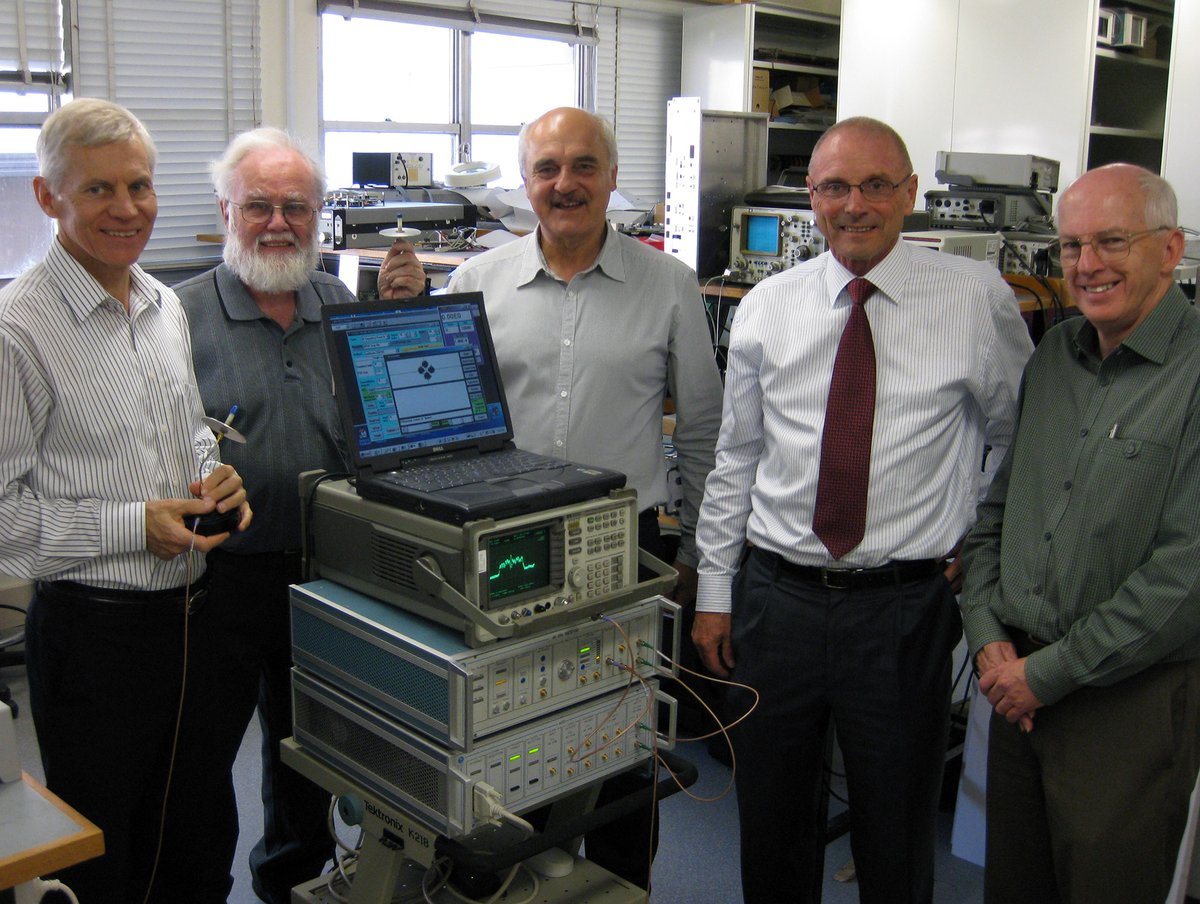
A major breakthrough for high-speed wireless networking came from Australia’s CSIRO team: John O’Sullivan, Terence Percival, Diethelm Ostry, Graham Daniels and John Deane. They developed technology to help wireless data survive the problems caused by radio signals bouncing off walls and other surfaces. Their “Wireless LAN” patent, US 5,487,069, was granted on 23 January 1996, following an Australian filing in 1992 and a US application in 1993.
© CSIRO
That is an important patent behind modern Wi-Fi. It is not a patent covering every part of Wi-Fi. Replacing “one woman invented everything” with “one man invented everything” would leave us with the same mistake and a different photograph.
What bothers me is the need to turn this into a competition at all. I respect feminism and people who put proper work into equality. Giving women credit for overlooked achievements matters. But watching a TikTok and immediately announcing that your gender won technology is not research. You have reached the end of a video, not the end of the investigation.
And before anyone uses this blog to claim feminists manufactured the whole story, I found no reliable evidence establishing that either. I cannot complain about people inventing history and then invent a culprit because it makes my argument more exciting. Although it would probably save me a lot of reading.
Lamarr’s real achievement deserves recognition. So does Antheil’s contribution, and so does the work of the people who developed Wi-Fi decades later. We can appreciate all of them without treating a patent record like the scorecard of an Argentina-England match.
I would rather share a slightly less dramatic story that is true than an impressive one that falls apart the moment someone checks it. Hedy Lamarr doesn’t need us to improve her achievements. She needs us to describe them properly.
And if your Wi-Fi is strong enough to upload a ten-minute argument, it is strong enough to open the source.
aKi Malik






No Comment! Be the first one.